Fascism is a legitimate threat in the United States of America. I am not being alarmist. There are many people who rightfully challenge the casual over-use of this term, and there are disagreements among academics about whether fascism ended in 1945. Those positions warrant consideration. However, I believe this term can be accurately applied post-WWII. I am certainly no expert, but I don’t think that is required of any of us in order to talk about it. I would like to unpack some of fascism’s complexities, and I hope you will hear me out.
America’s form of neo-fascism is flourishing today. Fascism will not look the same as it did in the past. It takes on slightly different qualities and imagery depending on its national and historical context. Essentially everyone agrees that Mussolini’s Fascist Party and Hitler’s Nazi Party are the two central and founding examples of fascism. While fascism may be traced back earlier, Mussolini coined the term “fascismo” at the end of WWI, and the beginning of fascism as we know it is typically cited as 1919 in Milan. Even Mussolini’s Italy and Hitler’s Germany had differences.
A quick reading of fascism’s elements will reveal what seems to be a mixture of the global left and global right on the ideological political spectrum. This contributes to the challenges of discussing it, especially in present-day America. Our common use of left-wing and right-wing is also relative to our dominant political parties. Adding to the potential confusion, Mussolini’s fascism was avowedly anti-capitalist before it came to power, but his primary enemies included Italian socialists and communists, and to achieve power he eventually aligned with capitalists. Hitler’s Nazi Party was officially the “National Socialist German Workers’ Party,” but the first concentration camp initially housed political prisoners, who were mostly socialists and Marxists. Additionally, while “the outermost reach of fascist radicalization was the Nazi murder of the Jews,” anti-Semitism was much different in Italy compared to Germany. So, I want to provide one definition of fascism that can help us understand its complex nature.
Robert Paxton, one of the leading and most well-respected scholars of fascism, describes fascism as “a form of political behavior marked by obsessive preoccupation with community decline, humiliation, or victimhood and by compensatory cults of unity, energy, and purity, in which a mass-based party of committed nationalist militants, working in uneasy but effective collaboration with traditional elites, abandons democratic liberties and pursues with redemptive violence and without ethical or legal restraints goals of internal cleansing and external expansion.” Defining fascism as “a form of political behavior” is an important point, as Paxton makes it clear that fascism is not a coherent ideological political system like the classical “-isms” such as conservatism, liberalism, and socialism. Rather, the “relationship of fascism to its ideology” was “peculiar,” as it was “simultaneously proclaimed as central, yet amended or violated as expedient.” As fascist leaders sought to obtain and retain power, they had no problem dismissing the intellectual foundations of their movements. To make sense of fascism, Paxton recommends focusing more on fascists’ actions rather than their words.
Fascism is explicitly anti-democratic. Fascist movements arose in the aftermath of the First World War which devastated Europe—especially Germany—and came to power during a time of global economic crisis. As the world’s liberal democracies were failing to meet the moment, people were seeking alternatives.
Paxton outlines five stages of fascism, noting that only Mussolini’s Fascists and Hitler’s Nazis reached the final stage. These stages are 1) creation of fascist movements, 2) their rooting as parties in a political system, 3) acquisition of power, 4) exercise of power, and 5) radicalization or entropy. He contends that there have been other “fascisms” around the world since 1945, but none have made it past stage two. In terms of American history, Paxton reaches back a bit further than 1919, claiming that the Ku Klux Klan during the post-Civil War era of Jim Crow was “functionally related to fascism” and “a remarkable preview of the way fascist movements were to function in interwar Europe.”
Trumpism is America’s neo-fascist movement. “Obsession with community decline” is apparent in Trump’s appeals to white nationalism and his call to “Make America Great Again.” This obsession over decline and concepts of “racial purity” come together in white supremacist propaganda found in the fringes of the movement for abortion restriction, and relate to the Great Replacement theory, which was cited in the online writings of the 18-year-old white man who targeted Black people when he killed 10 in a Buffalo grocery store. Tucker Carlson, who has the most-watched show on cable, echoes Great Replacement talking points when he speaks about immigration and demographic changes.
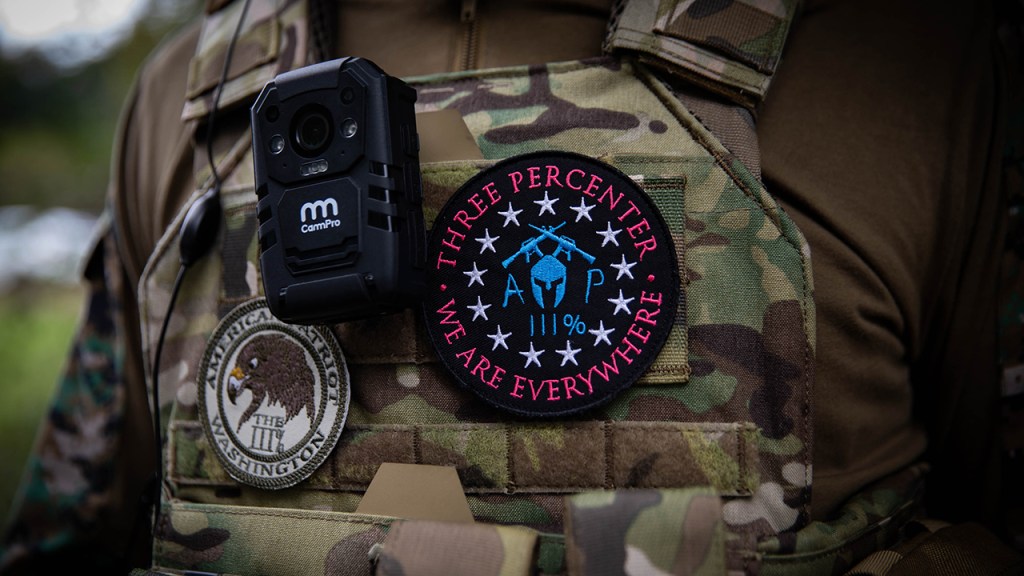
A populist and nationalist fervor related to “unity, energy, and purity” can be observed in Trump’s rallies, which are now titled “Save America.” The Proud Boys, Three-Percenters, National Alliance, Patriot Front, and the Oath Keepers are only a few examples of far-right nationalist militants who have been empowered in the era of Trumpism. Members of a far-right para-military group attempted to kidnap the Democratic Governor of Michigan in 2020. Machismo was also a component of fascism and is visible within these groups and in conservative reactions to non-conformity to sexuality and gender norms.
Furthermore, fascism involves an obsession with “internal enemies.” Trump has used hateful rhetoric and implemented discriminatory and restrictive policies in relation to immigrants, Muslims, and transgender people. He has shared white supremacist and anti-Black propaganda online. He has attacked what he calls the “woke Left” and mislabeled conservative, liberal, and progressive Democrats as “Marxists” and “Communists.” Fox News and alternative right-wing media promote and reenforce these misguided fears. Trump also used militarized federal officers in an authoritarian response to protests. Referencing Black Lives Matter protestors, he once asked his Defense Secretary, “can’t you just shoot them?” Trump said “Black Lives Matter” represented a “symbol of hate” and protestors were “terrorists” and “thugs,” while the armed mob that stormed the Capitol were “very special” and “great patriots.”
Trump’s favorite target has always been the free press, claiming that anything that does not benefit or glorify him is Fake News. He has vilified the news media in absurdly broad ways, stating that they are “truly the enemy of the people,” encouraging direct comparisons to Hitler. Trump has constructed a sphere of ‘alternative facts,’ promoted QAnon conspiracy theories, and even created his own social media app, “Truth Social.” Since the FBI raided his Florida mansion to obtain classified documents he illegally withheld, there have been increasingly more calls for violence and civil war from his supporters. Soon after the FBI raid this year, a man with a semi-automatic weapon attempted to enter an FBI headquarters in Cincinnati and was killed in a shootout with police.
Trump has continuously denied the outcome of the 2020 election, firmly establishing his anti-democratic and authoritarian views. There are many anti-democratic elements of our society, and we can critique gerrymandering, the Electoral College, voter suppression, and the two dominant parties’ undemocratic control over the election system, but the 2020 election was not won by Donald Trump. Sure, voter fraud does occur, but it is so incredibly rare that it is essentially a non-issue. There have been many independent audits and recounts, and even Trump-appointed judges have confirmed the results. A member of Trump’s own administration, leading an agency within the Department of Homeland Security, called the 2020 general election the most secure election in the nation’s history.
Trump’s political policies have never drawn exclusively from a specific political ideology. Instead, he has changed positions often, and is usually incoherently stating whatever gets the crowd riled up. He has utilized white identity politics, Christianity, nationalism, xenophobia, and selective populism to appeal to voters. He has stoked “culture wars.” He has done all of this for the purposes of obtaining and retaining power.
Robert Paxton resisted referring to Trump as a fascist. In 2017, he wrote an article encouraging us not to misuse that label. He said Trump’s administration was in fact a plutocracy: a government ruled by the wealthy. That changed after January 6th and the subsequent hearings. On the day electoral votes were to be officially certified by Congress, Trump encouraged the crowd to march “peacefully” to the Capitol, but he also said, “if you don’t fight like hell, you’re not going to have a country anymore,” and has used violent and incitive language on many occasions. Paxton now considers the fascist label to be appropriate.
I will take his analysis a step further. We are in stage two of fascism: the rooting as parties within the political system. 103 Republican candidates for office in the upcoming election have consistently denied the results of the 2020 election. Even more have gone back and forth about it or have “questioned” the results. Trump-supporting far-right extremists are being used to raise funds and boost candidates in some races. Most Republicans have been carefully playing politics by not denouncing Trump, hoping that they can receive the votes of both traditional Republican voters and Trump supporters. Again, anti-democratic values are not new in America, but this represents something further. The Fascist Party in Italy and the Nazi Party in Germany never got anywhere close to a majority of votes in elections. Instead, they had to form coalitions: “…the fascist route to power has always passed through cooperation with conservative elites.” If the traditional American elites and a multitude of conservative representatives within the Republican Party are continuously willing to align with radical anti-democratic candidates and the social-political movement that is behind them, we have entered a new phase. We should be prepared for extremist right-wing violence following each upcoming election.
It has been argued that we are not in a similar crisis to that of post-WWI Europe. Even though the pandemic has disrupted the world’s global capitalist economy, and even pre-pandemic, our mixed economy is prone to boom-and-bust cycles and is not favorable to the working- and middle-class, it is said we are not yet in a similar crisis where liberal democracy fails to uphold the economy. Though, I often feel like we are one economic or gas crisis away from grocery stores becoming empty. The world is increasingly unstable due to climate change. There is still a global pandemic. And we are all simply hoping Russia’s imperialism, China’s growing militarism, and the West’s response does not lead to a Third World War or nuclear devastation. Are we going to have a fascist leader while these crises continue to unfold?
There are no easy answers. I am only trying to make sense of our socio-historical and political context. I am absolutely not saying that every individual who voted for Trump is a fascist. I am saying that Trumpism, an election-denying socio-political movement, is a fascist movement, and it is now in the process of taking deeper root within our political establishment. We should not underestimate Trump because he occasionally seems utterly foolish. His administration was filled with educated individuals who seized the opportunity to explore far-right extremism. It is the movement Trump has galvanized that is my central concern. A variety of reasons led to fascism’s past exclusion to the margins of American society, but it is now front-and-center. Its seeds are sprouting in America and abroad. The atrocities committed by the Nazis are so horrifying that it is almost hard to imagine. I worry that some Americans have forgotten what human beings are capable of doing to other human beings. Trump may or may not continue to be the central figure of the neo-fascist movement in the coming decade. Fascism allows for changes so it can continue to thrive. So we need to be vigilant and consider the signs.
I believe America’s neo-fascism will use violent rhetoric, policy, and action to target immigrants, indigenous people, non-white people, members of religious minority groups, unhoused people, people with disabilities, and gay, lesbian, queer, non-binary, gender non-conforming, & transgender people. Additionally, America’s neo-fascism will embrace patriarchy and machismo and try to control women’s bodies. Ultranationalism, anti-democracy, and anti-pluralism will be identifiable features in American neo-fascism. The most violent actors will likely be white men who are members of self-proclaimed white nationalist groups. This is my perspective. Let’s say you consider Robert Paxton’s analysis to be wrong, or believe I am misusing it, or you do not agree with the label of fascism. Well, these features are still present in our society. There is still significant cause for concern.
You may think it is hyperbole or inaccurate to call the United States an oligarchy or plutocracy, but I believe we closely fit those definitions. Our federal and state politics are primarily controlled by major special interest groups, major corporations, and people with exorbitant wealth. Historically, major social movements or immense economic crises are the only ways the American political system has changed for the benefit of the working and middle classes. The only chance individuals like you and I have to change our society before the next major crisis seems to be coming together—mass collective action. I think a major reorienting of our social and political lives may be necessary to meet the threat of fascism. We have to connect to our community and engage in them in radically different ways to create a coalition of people who value equity and have respect for human dignity. I think it is ill-advised to rely solely on our current government and political institutions to save us. We need each other. We need a mass grassroots movement of people to present a counter to fascism.
Sources
Paxton, Robert O. 2005. The Anatomy of Fascism. 1st Vintage Books ed. New York, Vintage Books.
Purchase: https://www.penguinrandomhouse.com/books/128540/the-anatomy-of-fascism-by-robert-o-paxton/
The Five Stages of Fascism by Robert O. Paxton
Source: The Journal of Modern History, Vol. 70, No. 1 (March 1998), pp. 1-23 Published by: The University of Chicago Press
Stable URL: http://www.jstor.org/stable/10.1086/235001
Free PDF: https://pryan2.kingsfaculty.ca/pryan/assets/File/Paxton’s%205-Stages%20of%20Fascism.pdf
“I’ve Hesitated to Call Donald Trump a Fascist. Until Now” | Opinion
Robert O. Paxton – 1/11/21
https://www.newsweek.com/robert-paxton-trump-fascist-1560652
NY Times: “These Republican Candidates Questioned the 2020 Election”
https://www.nytimes.com/interactive/2022/10/13/us/politics/republican-candidates-2020-election-mGisinformation.html
Featured Image: Getty/Maranie R. Staab
 Transgress Boundaries
Leave a comment